
Annika Rhea
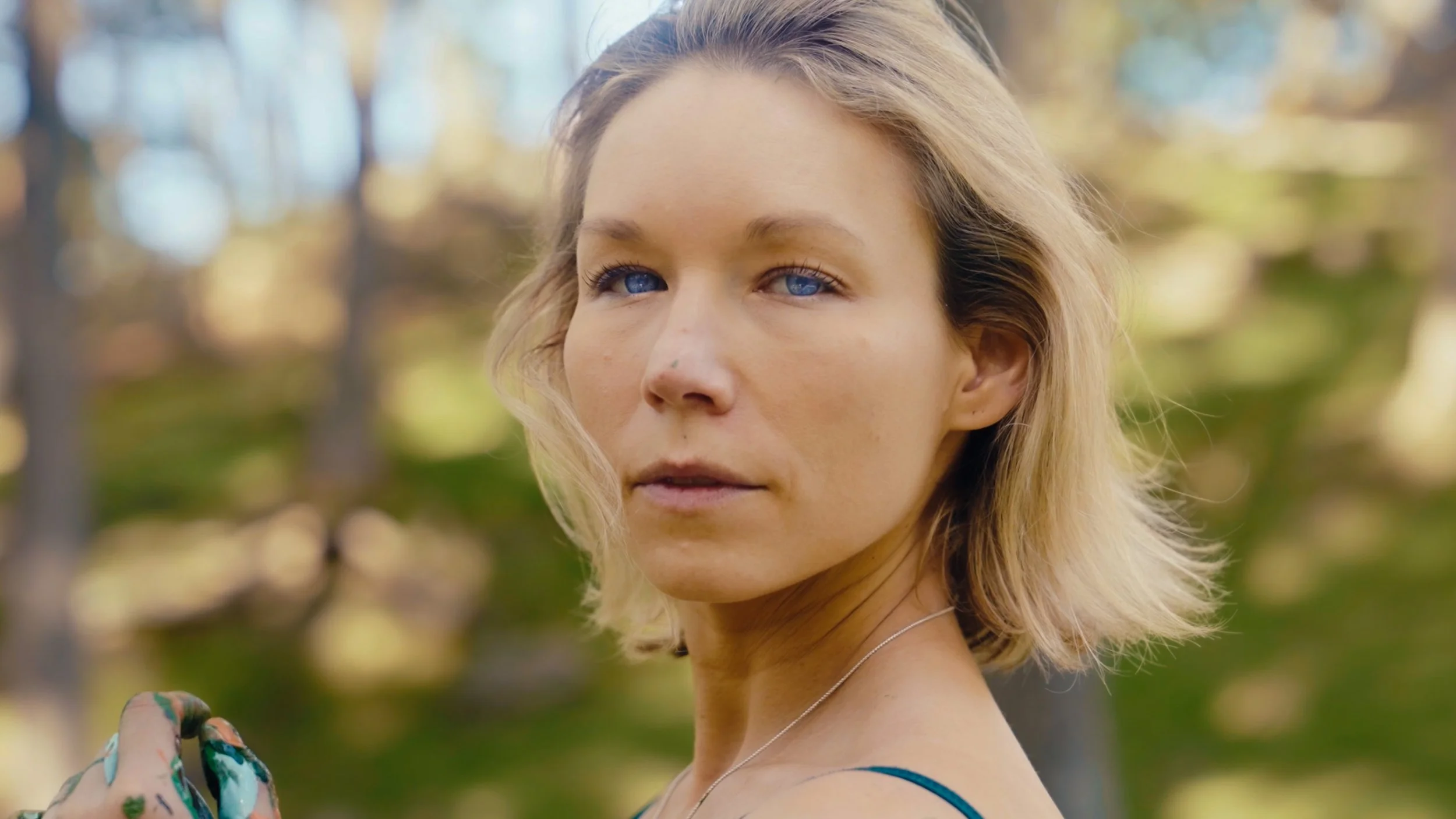
A body meets paint.
Paint meets gravity.
A moment meets a room full of people holding their breath.
Before anyone knows what the piece will become, Annika Rhea is already moving. Bare feet on the canvas. Color waiting to land. There’s no undo button here. Just presence.
“Art is a moment of truth,” she says early on. “When one entity is touched by another.”
That sentence kind of sets the tone for the day.
Annika has been painting professionally for fourteen years. Dancing for fourteen years too. For a long time, those worlds lived side by side. Parallel tracks. Until 2016, when she stopped asking herself to choose.
Instead, she built something new.
She calls it body medium.
Her body becomes the brush.
Motion becomes the stroke.
The canvas becomes a stage.
What unfolds is part performance, part ritual, part abstract expressionist painting in real time. It’s loud and quiet at the same time. Messy and intentional. Alive.
“I think of it as rapid creative problem solving,” she explains. “When I put down the paint, I can kind of know where it’s going to go. But when it lands, I can’t wipe it up. I can accept that it’s there and adapt to it.”
That acceptance is the work.
Every performance starts with a meditation. Annika invites the audience into the process before a single mark is made. Not as spectators, but as collaborators.
“I’m just the vessel making this piece,” she says. “What makes the piece is the collective energy we’re putting into it. This is a moment. This is a memory that we’re co-creating together.”
You can feel how seriously she takes that responsibility. The goal isn’t spectacle. It’s connection. She wants people to leave feeling like they didn’t just watch something, but belonged to it.
There was a time, though, when that clarity wasn’t so steady.
Someone once told her to pick one discipline. To simplify. To be legible.
Instead, Annika did the opposite.
“I said, okay, you can do anything with any craft,” she remembers. “So I’ll invent one that has everything I’m passionate about in it.”
That decision wasn’t just artistic. It was existential.
Later, during a low moment, she called a mentor. Things weren’t working. Momentum felt fragile. Quitting felt close.
Her mentor’s advice was simple. Almost blunt.
“Just keep pounding the pavement.”
Persistence. Showing up. Fighting for your work. Saying, I’m worth it, even when no one else is saying it yet.
That idea stuck.
Today, Annika talks a lot about why. Not aesthetics. Not opportunities. The deeper question underneath all of it.
“What are you trying to communicate?” she asks. “How can you make the world a better place? How can you inspire? What do you want to leave behind?”
The pieces will come and go. Shows will rise and fall. Things will break. Things will work. But that why is what carries her through the uncertainty.
Near the end of the day, she says something that feels less like a quote and more like a release.
“When I reach the canvas,” she pauses, smiling, “no one’s telling me what to do.”
A beat.
“I’m free.”
And watching her move through paint, through doubt, through motion, you believe her.