
Maverick McConnell
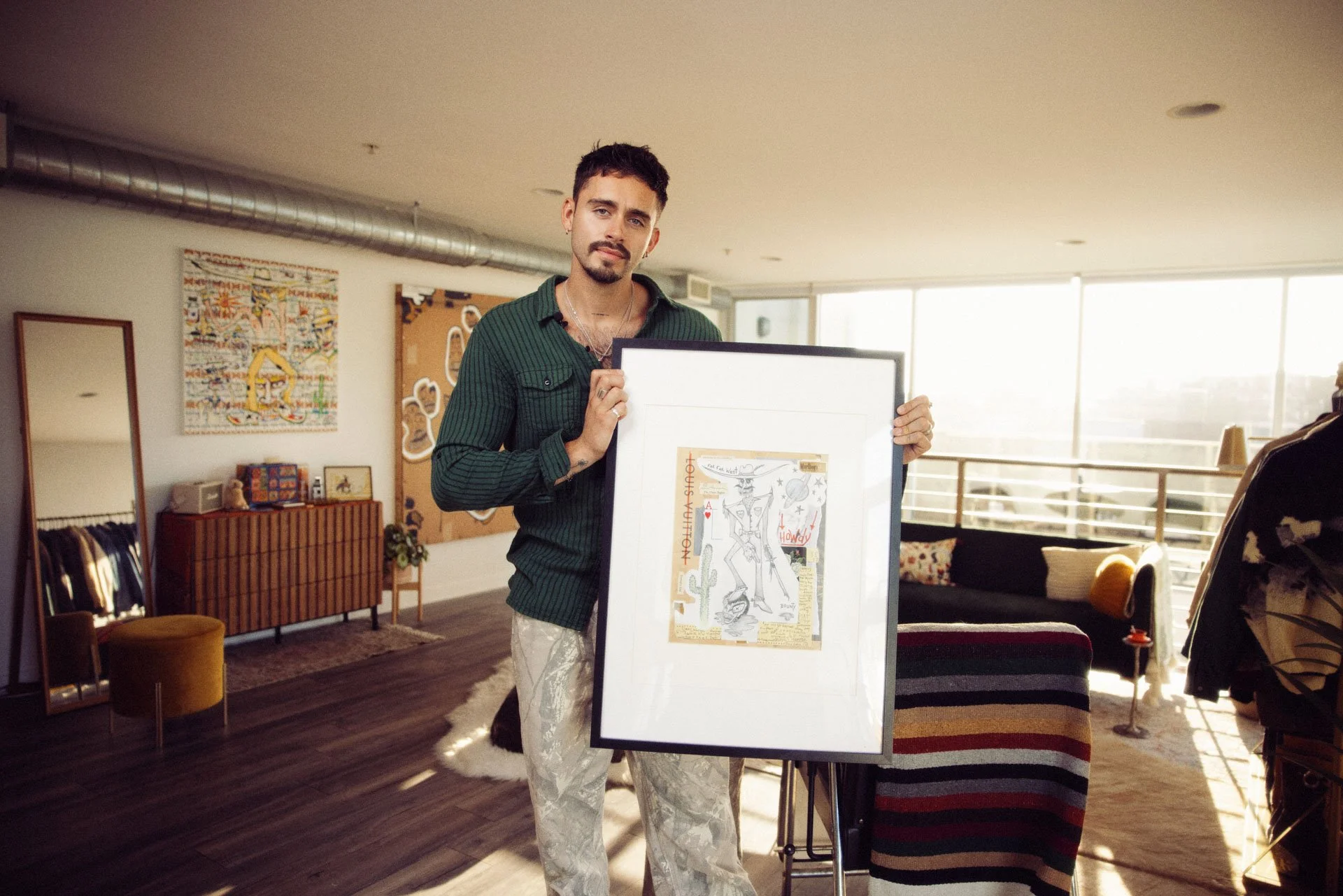
A piece of cardboard leaning against a dumpster.
Sharpie ink still smelling fresh.
A face beginning at the nose.
That is where we meet him.
Before the name. Before the work finds walls. Before anyone calls it art.
For Maverick McConnell, drawing was never about becoming something. It was about surviving something.
He talks about growing up inside chaos. About feeling like a kid stuck in the middle of a hurricane. And somehow, inside that noise, he found stillness. Drawing gave him that. The world would melt away. The lines became shelter. A private place where things finally made sense.
That relationship never left him.
He has been drawing faces for as long as he can remember. Always faces. Always different.
Two eyes. A nose. A mouth. Ears.
The same ingredients. Infinite outcomes.
“I’ve never drawn the same face twice,” he tells us. And you believe him immediately. Thousands of faces later, he is still curious. Still obsessed. Still amazed that identity can live inside such a small set of rules.
There is something quietly radical about that focus. In a world chasing novelty, Maverick keeps returning to the same human starting point. Over and over. Forever, if he can.
The materials matter less.
Growing up without resources taught him that. You do not wait for the right tools. You use what is around you. You adapt. You make it work.
Cardboard. Trash. Discarded objects. A Sharpie.
This is where MR. TRASH BOY is born.
The name started as a graffiti tag. A joke. A truth. A declaration of love for what most people ignore. He sees value where others see nothing. Potential where others walk past without looking.
On one night walk, he found a piece of trash sitting outside a dumpster and brought it home.
“It felt like it needed to be something.”
Fifteen minutes later, it was art.
That moment is the whole thesis. Take what is overlooked. Give it attention. Let it breathe. Let it become.
And then he says something that lands harder than any technique.
“That kind of relates back to myself.”
He does not say it dramatically. He does not need to. You understand exactly what he means.
There is no rush in his process. No urgency to turn this into money. No pressure to scale or package or optimize the thing that saved him.
His art is therapy. It is grounding. It is necessary.
No matter where he is in life, he must create.
That is the throughline. Not ambition. Not validation. Creation as survival. Expansion as obligation. Expression as proof of life.
Sharpie and cardboard. That is it.
And somehow, it is everything.
When we leave him, the faces remain. On walls. On scraps. On objects that once lived in the gutter.
None of them the same. All of them human.
Still becoming.